
Auckland families seeking exceptional early learning turn to centers like Blooming Buds, serving New Lynn and Glen Eden with age-appropriate rooms spanning infancy through preschool. Qualified educators deliver structured, play-based programs that build cognitive, social, and emotional foundations, preparing children for school readiness while partnering closely with parents throughout each developmental stage.
Key Takeaways
- Blooming Buds Early Learning Center provides exceptional childcare in Auckland with personalised care plans.
- Our close-knit center focuses on individual child interests and developmental needs every single day.
- We maintain smaller group sizes to ensure quality attention and meaningful relationships with each child.
- Blooming Buds delivers family-centred early learning that supports each child’s unique personality and growth.
What Makes an Auckland Early Learning Center Exceptional?
Exceptional early learning centers in Auckland combine choice, curriculum, and purpose-built design to support a child’s growth. Families across the region can select from multiple licensed childcare groups, some of which operate several centers spanning different suburbs. This variety gives parents room to compare philosophies, room ratios, and daily routines before enrolling a child.
Curriculum quality separates a merely adequate program from a genuinely exceptional one. Many Auckland providers, including early learning center auckland operators, build their programs on Te Whāriki, the national early childhood curriculum framework. This shared foundation weaves learning priorities together with input from parents. Whānau, giving children consistent developmental milestones no matter which suburb they attend.
Blooming Buds Early Learning Center serves families throughout Auckland, bringing this same commitment to structured, play-based learning into its daily programming. Facilities matter just as much as curriculum. A purpose-built, architecturally designed space gives children room to explore safely, move freely, and engage with age-appropriate equipment.
What should parents look for when comparing ECE centers in Auckland?
Parents evaluating ece centers auckland should weigh three factors together: curriculum grounding, physical environment, and educator-to-child ratios. A center built specifically for early learning typically outperforms retrofitted spaces on safety and sensory design.
Does a bigger center network mean better quality?
Not necessarily. Larger groups offer consistency and shared resources across locations, while smaller centers often provide closer relationships between educators and families. Consider these factors:
- Curriculum alignment with Te Whāriki
- Purpose-built indoor and outdoor learning spaces
- Availability across multiple Auckland suburbs
- Balance between structured activities and free play

How Does Play-Based Learning Build Real Skills?
Genuine skill-building happens when children direct their own play while trained educators quietly shape the experience around learning goals. Early childhood education plays a pivotal role in shaping a child’s future learning success. The years spent stacking blocks, negotiating turns, and inventing stories carry more academic weight than they appear to on the surface. Skipping structured play in favor of passive activities costs children chances to build the exact skills kindergarten classrooms expect on day one.
Quality programs at an early learning center auckland families trust don’t isolate development into separate boxes. Cognitive growth, emotional security, and social skills develop together, each reinforcing the others as children move through a normal day of play. A child negotiating a turn on the slide practices patience, language, and problem-solving all at once.
Engaging, hands-on activities stimulate cognitive growth directly. Peer interaction during that same play builds the social skills children need for group settings later on. Puzzles sharpen reasoning. Pretend play builds vocabulary and flexible thinking. Group games teach cooperation before a child ever sits in a formal classroom.
What does play-based learning actually look like day to day?
At well-run ece centers auckland families rely on, play looks purposeful rather than random. Sessions typically blend:
- Sensory and building activities that develop fine motor control and early problem-solving
- Group games and dramatic play that build turn-taking, negotiation, and language
- Quiet exploration corners that support focus and emotional regulation
Does center size affect the quality of play-based learning?
Smaller centers can offer particularly warm, nurturing environments for children from infancy through preschool age. Closer educator-to-child relationships allow play to be tailored to each child’s interests and pace, rather than following a one-size-fits-all script.
Which Age Groups and Programs Fit Your Child?
Blooming Buds welcomes children from infancy through to preschool age, with programs matched to each stage of growth. Families across Auckland searching for an early learning center Auckland parents can trust often want reassurance that the room their child enters actually fits their needs. That match matters: a toddler placed in an infant setting misses stimulation. An infant placed among older preschoolers loses the calm, close supervision babies need.
Programs are structured by developmental stage, so every child receives care and education suited to where they are right now. This staged approach shapes daily routines, room layouts, and educator interaction across ECE centers Auckland families rely on for consistency and continuity.
What does an infant program actually involve?
Infant programs serve children under 2 years old and center on nurturing care paired with sensory exploration. Educators focus on touch, sound, and movement experiences that build early neural connections. Gentle routines around feeding, sleep, and comfort stay consistent, giving babies a predictable, secure base.
How do programs change as children get older?
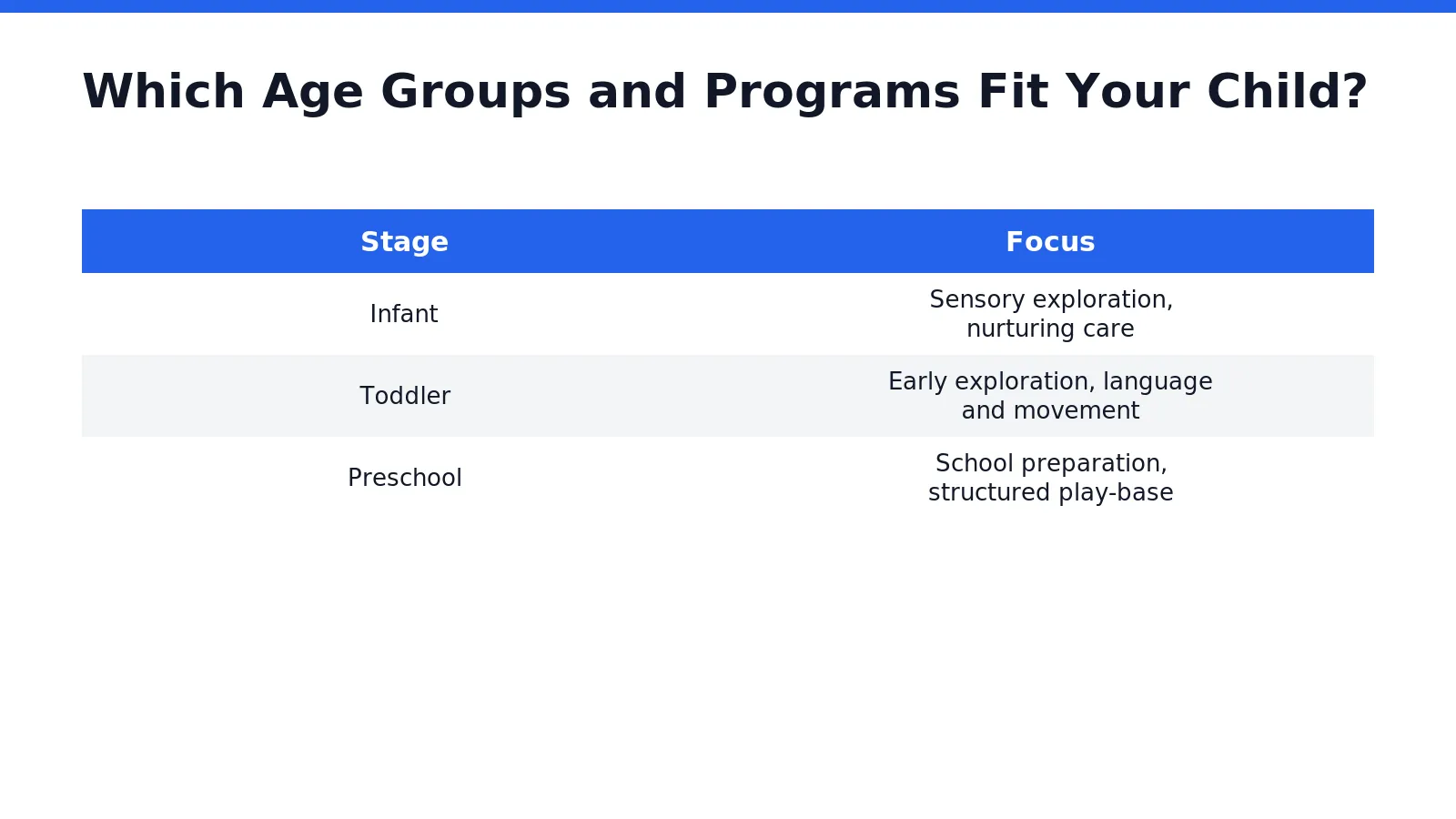
Age-appropriate rooms carry children from early exploration through to school preparation, each stage building on the last. The table below outlines the general progression:
| Stage | Focus |
|---|---|
| Infant | Sensory exploration, nurturing care |
| Toddler | Early exploration, language and movement |
| Preschool | School preparation, structured play-based learning |
Structured transitions between rooms reduce disruption. Children move forward only when developmentally ready, not by calendar age alone. This keeps learning paced to the individual child rather than a fixed timeline.

How Do Centers Keep Children Safe Each Day?
Safety ranks as the highest priority at Blooming Buds, guiding every decision made across daily operations in Auckland. Strict supervision ratios keep qualified educators closely attentive to each child. Secure entry systems prevent unauthorised access to the premises. Regular health checks and clear safety procedures round out a system designed to protect every child in care.
These safeguards work together rather than in isolation. A single weak point, like an unsupervised doorway or an inconsistent check-in process, undermines the whole system. Auckland families searching for a licensed early learning center auckland should expect these layered protections as standard practice, not an optional extra.
What safety measures should parents look for in Auckland childcare?
Parents evaluating ece centers auckland should ask directly about supervision ratios, entry protocols, and health screening routines. The strongest programs combine all four elements:
- Consistent supervision ratios maintained throughout the day
- Secure entry systems that control who enters and exits
- Regular health checks to catch concerns early
- Clear, written safety procedures followed by every educator
Blooming Buds New Lynn operates as a licensed early learning center in Auckland, offering quality childcare within a safe, thoughtfully designed environment.
How does safety fit into the daily schedule?
Safety isn’t a separate task bolted onto the day; it’s woven into the rhythm itself. Structured learning activities, creative play, outdoor exploration, meal times, rest periods, and social interaction all happen within that protected framework. Routine gives children predictability, while flexibility allows educators to respond to individual needs without compromising oversight. This balance reassures Auckland families that their child is both nurtured and closely watched, hour by hour, from drop-off to pickup.
How Do You Choose and Enrol With Confidence?
Confident enrollment starts with early action and a clear look at daily logistics. Auckland families weighing an early learning center auckland search often feel overwhelmed by choice. Finding the right childcare solution can feel daunting for busy working parents juggling drop-offs, pickups, and unpredictable workdays. A structured approach turns that stress into a manageable checklist.
Timing matters most. Nursery and toddler spaces at Blooming Buds fill quickly, and availability across its centers shifts week to week. Waiting until enrollment feels urgent risks missing a spot entirely. Booking a tour early gives families first access and time to ask questions before a decision is needed.
Operating hours deserve equal attention. Blooming Buds New Lynn runs Monday through Friday, 7:00am to 6:00pm. A schedule built for parents managing full workdays and commutes across West Auckland.
What Should Parents Look For in ECE Centers Auckland-Wide?
Beyond hours and availability, parents evaluating ECE centers Auckland wide should prioritize genuine partnership. Strong relationships between whānau and educators shape how well a child settles in and learns. Ask how a center communicates daily progress, welcomes family input, and involves parents in curriculum decisions.
How Far in Advance Should Families Book a Tour?
Booking as soon as a family begins considering care is the safest approach. Because room availability changes regularly, early inquiries protect against disappointment later.
A simple enrollment checklist helps families stay organized:
- Confirm room availability for the child’s age group
- Compare operating hours against work schedules
- Ask about family communication and partnership practices
- Schedule a tour before finalizing a decision
Following these steps builds confidence long before the first day begins.
FAQ
What makes Blooming Buds an exceptional early learning center in Auckland?
Blooming Buds delivers personalised care plans, smaller group sizes, and family-centred programming that supports each child’s unique interests and developmental needs every day.
What should parents look for when comparing early learning centers in Auckland?
Parents should weigh curriculum grounding in Te Whāriki, purpose-built indoor and outdoor learning spaces, and educator-to-child ratios that ensure close relationships and quality attention.
How does play-based learning at Blooming Buds prepare children for school?
Qualified educators shape structured, play-based programs around learning goals, building cognitive, social, and emotional foundations that support genuine school readiness.
Conclusion
In closing, Blooming Buds Early Learning Center stands as a trusted partner in your child’s foundational years, offering the nurturing environment and expert guidance that early learners deserve. Our commitment to play-based learning, developmental growth, and school readiness reflects our dedication to supporting each child’s unique journey. When you choose Blooming Buds, you invest in a center where your family’s wellbeing and your child’s flourishing remain at the heart of everything we do.