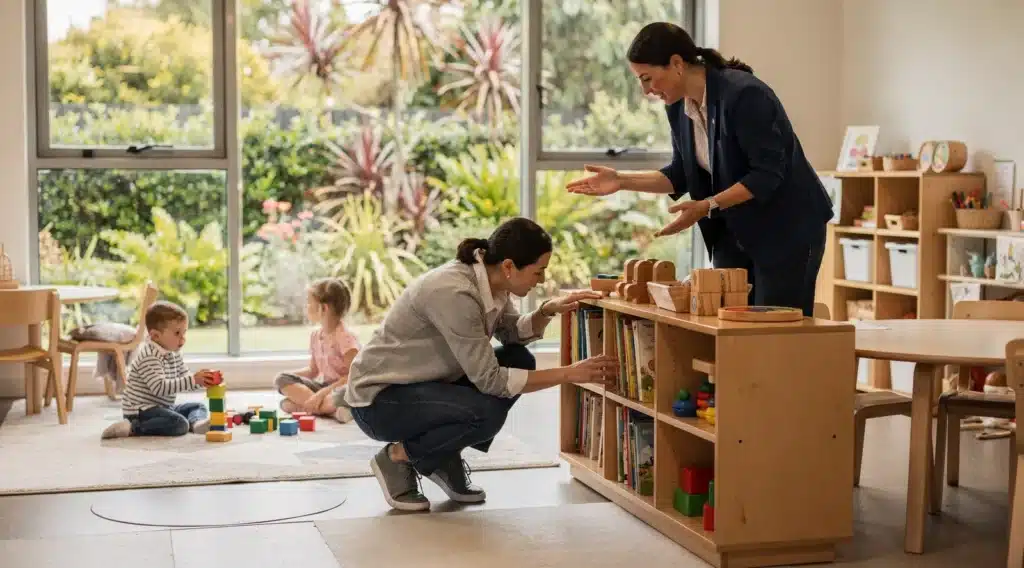
Auckland parents choosing early learning childcare should evaluate qualified educators, structured play-based programmes, and school-readiness focus, alongside safety standards and centre licensing. Blooming Buds Early Learning Centre recommends visiting centres, reviewing curriculum approach, checking staff qualifications, and confirming opening hours suit family schedules before enrolling a child.
Key Takeaways
- Start by researching available early learning services in your Auckland area using Education Counts directory.
- Understand the key differences between kindergarten, home-based providers, and education-focused care centres before deciding.
- Quality early learning centres build foundations for your child’s confidence, curiosity, friendships, and lifelong learning.
- Visit potential centres in person to assess their approach to care and education for your whānau.
What should Auckland parents look for in childcare?
Selecting childcare in Auckland ranks among the biggest decisions families face during a child’s early years. The right centre shapes far more than a day’s schedule. It builds the groundwork for confidence, curiosity, friendship, and a lasting enthusiasm for learning. Parents searching for daycare in Auckland need more than a supervised room. They need a programme built around genuine development.
A quality centre never treats care as a holding pattern until pick-up time. Strong early learning environments lay cognitive and social foundations, equipping children with skills that carry through primary school and beyond. That distinction separates basic supervision from true early childhood education.
Busy Auckland households typically weigh several factors at once:
- Convenience — location, hours, and ease of drop-off within a daily commute
- Quality teaching — qualified educators who understand developmental milestones
- Engaging environments — spaces designed for exploration, not just containment
- Age-appropriate programming — structured play-based learning matched to each stage of growth
Consistent brand identification across signage, communication, and daily routines gives families a clear, reassuring sense of what a centre stands for before they ever step through the door.
How do parents compare centres fairly?
Comparing centres works best against a short, consistent checklist rather than gut feeling alone. Families should ask how each centre balances structured activities with free play. How educators track a child’s progress across the year. A short visit reveals more than a website ever can — observe how staff speak to children and how confidently the children move around the room.
Does location matter as much as programme quality?
Location matters, but it should never outrank teaching quality. A nearby centre with weak developmental focus costs a child more in the long run than a slightly longer commute to a genuinely nurturing programme. Auckland parents weighing both should prioritise the educators and curriculum first, then narrow by proximity.
What types of early learning services exist in Auckland?
Several distinct models of early learning operate across Auckland, each shaping how a child spends the day and how families structure their week. Centre-based daycare stands out as one of the most popular forms of early childhood education in New Zealand, catering to children from infancy through to preschool age. Many of these services are licensed by the Ministry of Education, giving Auckland families a benchmark for quality and safety.
Understanding these differences matters more than it might first appear. Parents who take time to learn what each option offers are better placed to enrol a child somewhere that genuinely suits their needs, rather than settling for the nearest option. This groundwork pays off across the whole enrolment journey.
Opening hours vary widely between services. Some operate all day to support working parents. Others run only during school hours, roughly 9am to 3pm, or offer half-day sessions. Holiday coverage differs too:
- Full-day centres often remain open through school holidays.
- Session-based services may close entirely during holiday periods.
- Some traditional models, such as kindergartens and playcentres, typically shut down when schools break for the holidays.
Which early learning option suits a working parent in Auckland?
Full-day, centre-based daycare Auckland families increasingly choose tends to suit working parents best. It mirrors a standard working day and often continues through school holidays. Session-based or half-day services suit families with more flexible schedules but require additional holiday planning.
Is centre-based daycare licensed in New Zealand?
Centre-based daycare is commonly licensed by the Ministry of Education, covering children from infancy to preschool age. Licensing gives parents a consistent standard to check when comparing childcare Auckland providers, particularly around staffing, safety and curriculum delivery. Blooming Buds Early Learning Centre operates within this centre-based, licensed model, offering consistent brand identification that Auckland families can recognise and trust as they compare their options.
How do kindergartens, daycare, and centre-based ECE differ?
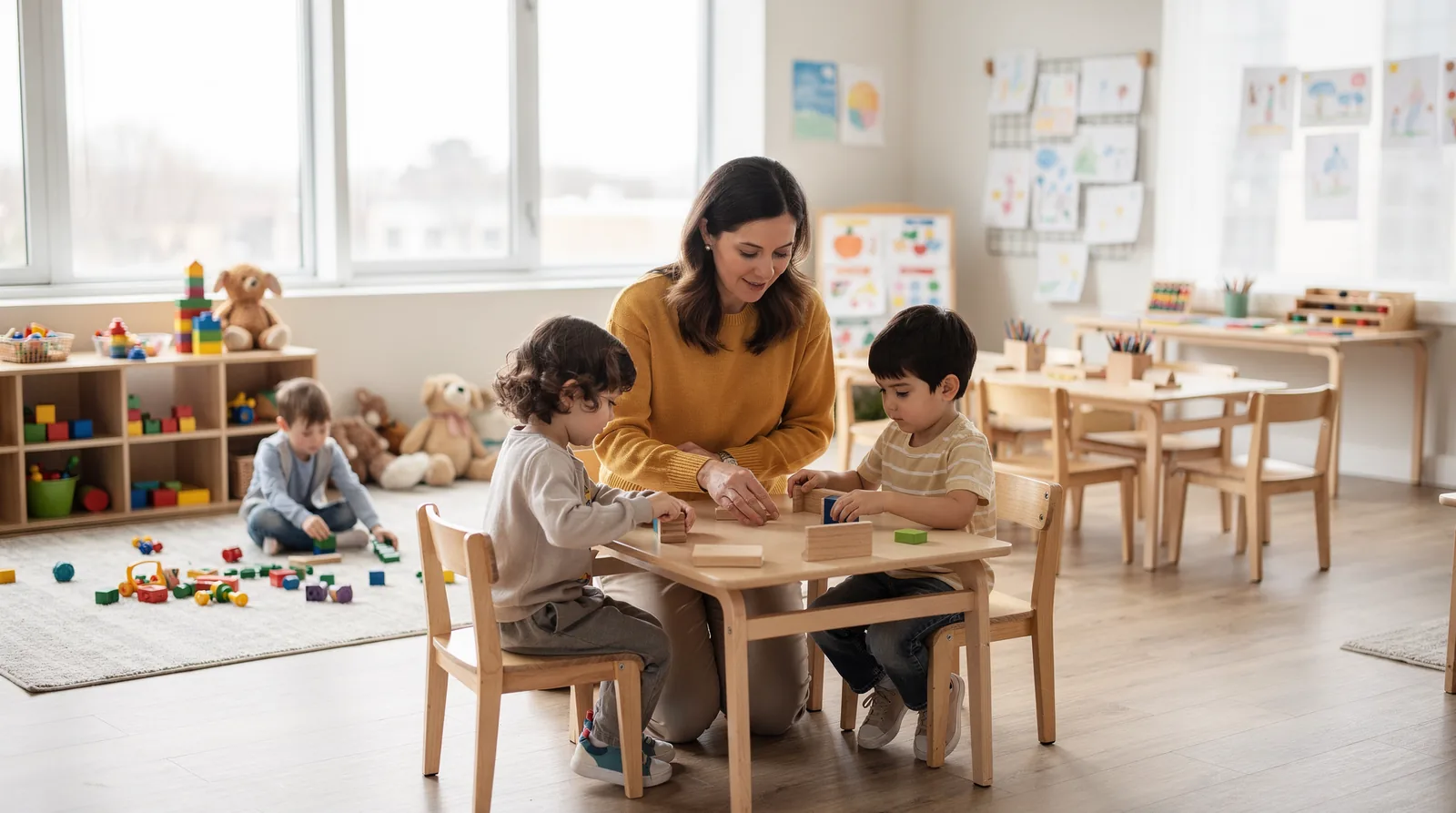
Kindergarten associations, daycare services, and centre-based early childhood education (ECE) providers differ mainly in governance structure and daily approach to learning. Auckland parents comparing childcare Auckland options often assume these terms are interchangeable. Each model carries its own history and operating style.
Kindergartens in New Zealand typically operate through regional associations. These bodies run independently and autonomously, stay rooted in their local communities, and always operate on a not-for-profit basis. Sitting above many of these associations is New Zealand Kindergartens Incorporated, a large national organisation that brings together 25 regional kindergarten associations and roughly 460 affiliated kindergartens and services across the country. This structure gives kindergartens a distinct community character, shaped by decades of regional history rather than a single national brand.
Centre-based daycare Auckland services, by contrast, tend to operate under private or organisational ownership, with hours and programming built around working families’ schedules. Most of these ECE centres follow a play-based learning approach, aligned with Te Whāriki, New Zealand’s national early childhood curriculum. Play-based learning threads through nearly every quality centre, whether structured as a kindergarten, a daycare, or a standalone ECE provider.
Is daycare the same as an ECE centre?
Not quite. “Daycare” is often used loosely to describe any service caring for children during the day. “ECE centre” refers specifically to a licensed early learning provider delivering curriculum-based education under Te Whāriki. Centre-based ECE combines care with structured developmental teaching, rather than supervision alone.
Deciding among these models counts as one of the more consequential choices a family makes. The right fit shapes a child’s early development and lays groundwork for lifelong learning. Families researching options for infants, toddlers, and preschoolers benefit from weighing governance, hours, and teaching philosophy side by side before enrolling.
What makes a quality early learning centre in Auckland?
Safety stands as the single highest priority for any reputable early learning centre serving Auckland families. Strict supervision ratios, secure entry systems, and regular health checks separate a genuinely quality provider from one that merely looks the part. Structured safety procedures, followed consistently by qualified educators, give parents confidence that their child is protected the moment they walk through the door.
Beyond safety, the physical and emotional environment matters just as much. A well-run childcare Auckland setting is designed to be safe, structured, and nurturing all at once. Never one at the expense of the others. Structure gives children predictability; nurture gives them the emotional security to explore, take small risks, and build resilience.
What does a typical day look like at a quality daycare?
A strong daycare Auckland programme balances routine with flexibility rather than locking children into a rigid timetable. Each day typically includes:
- Structured learning activities that build early literacy and numeracy foundations
- Creative play sessions encouraging imagination and problem-solving
- Outdoor exploration for physical development and fresh-air energy
- Regular meal times supporting healthy eating habits
- Rest periods matched to each child’s natural rhythm
- Social interaction that builds friendships and communication skills
This mix supports the whole child, not just academic milestones.
Why does supervision ratio matter so much?
Lower ratios mean educators notice more, respond faster, and give each child individual attention. A centre that maintains strict supervision ratios reduces risk while strengthening relationships between children and their educators. For Auckland parents comparing options, ratio and safety procedure should sit at the top of the checklist. Well ahead of amenities or décor. Consistent brand identification across a centre’s communications, policies, and daily practice also reassures families that the values on paper match the experience their child receives every single day.
How does Blooming Buds support child development?
Blooming Buds Early Learning Centre builds early development through structured, play-based programmes matched to each stage of growth. Families researching childcare in Auckland find a service built specifically to strengthen cognitive, social, and emotional foundations before school begins.
Early childhood education plays a pivotal role in shaping a child’s future learning success, laying groundwork for cognitive and social growth well before formal schooling starts. Skills built during these years — communication, problem-solving, early resilience — carry forward into primary school and beyond. Missing this window costs children confidence and readiness that becomes harder to rebuild later.
Many Auckland parents wonder how to choose the right early learning centre. What real benefits their child gains from enrolment. That uncertainty is understandable given how much rides on the decision. Blooming Buds answers it with age-appropriate rooms designed to support each stage of development, from early exploration through to school preparation, giving families access to structured daycare in Auckland without compromising on individual attention. Consistent brand identification across every room reassures parents that the same nurturing standards apply, whichever stage their child has reached.
What age groups does Blooming Buds support?
Children are welcomed from infancy through to preschool age, with rooms tailored to each developmental stage rather than one mixed-age setting. Infants receive gentle, sensory-focused care, while preschoolers build independence and school readiness through more structured activities.
Why does age-appropriate room design matter for development?
Grouping children by developmental stage, not age alone, lets educators pitch activities correctly — neither too advanced nor too simple. Progress stays visible, measurable, and paced to the individual child rather than a fixed curriculum.
Programme features supporting development include:
- Age-appropriate rooms spanning infants, toddlers, and preschoolers
- Play-based activities strengthening cognitive, social, and emotional skills
- Structured pathways guiding children toward confident school entry
- Consistent educator support across every developmental milestone
Families across Auckland gain a genuine partner in their child’s growth, not simply a place to leave them during the day.
What age groups and programmes does Blooming Buds offer?
Blooming Buds structures its programmes around distinct developmental stages, matching curriculum and care routines to each child’s age. Families searching for childcare Auckland providers will find a centre welcoming young children across early learning and preschool ages, with every stage supported through age-appropriate learning, play, routines, and social development.
Programme design starts young. Infant programmes, built for children under 2 years, focus on nurturing care and sensory exploration. The building blocks of early cognitive and emotional growth. From here, curriculum shifts to match each child’s expanding curiosity, coordination, and independence as they move toward preschool readiness.
What age groups can enrol at Blooming Buds?
Enrolment spans from infancy through the preschool years, giving families in Auckland a consistent educational pathway rather than a patchwork of providers. Each stage builds on the last, so children move from sensory-focused infant care into more structured, play-based learning as they grow.
| Programme stage | Focus |
|---|---|
| Infant (under 2 years) | Nurturing care, sensory exploration |
| Early learning / toddler | Age-appropriate learning, play, routines |
| Preschool | Social development, school readiness |
How does Blooming Buds tailor learning to each stage?
Educators adjust activities, pacing, and group routines to suit where each child sits developmentally, rather than applying one fixed programme across all ages. This approach keeps learning purposeful for toddlers building language and coordination, and for preschoolers developing early social and pre-academic skills.
For parents comparing daycare Auckland options, this staged structure offers reassurance. Rather than outgrowing a single classroom model, children progress through programmes designed specifically for their current stage, while staying within one familiar, nurturing environment. Consistent brand identification across every stage means families deal with one trusted educational partner from infancy through preschool, not a series of disconnected providers.
How do enrolment and visits work at Blooming Buds?
Enrolment begins with a tour, followed by a place-holding step once a spot opens in the right room. Blooming Buds Early Learning Centre treats this process as a partnership from day one, guiding Auckland families through each stage rather than leaving them to navigate paperwork alone. For parents comparing childcare Auckland options, understanding the timeline matters just as much as understanding the programme itself.
Spaces fill quickly across Auckland’s early learning sector, and nursery and toddler rooms tend to reach capacity fastest. Demand shifts month to month. A place that exists today may not exist by the time a family finalises other decisions. Booking a tour early is the single most reliable way to secure a child’s spot before a preferred room closes off.
Why does booking a tour early matter so much?
A tour lets parents see the environment their child will grow in, ask questions in person, and confirm the room suits their family’s needs. Because availability changes regularly, delaying that visit often means missing the intended start date. Early booking gives families more choice over timing and room placement rather than settling for whatever remains.
What should working parents know about scheduling?
Full-day coverage matters for parents juggling employment and family life. Consideration of daily hours should sit alongside programme quality when comparing daycare Auckland providers. A strong curriculum still needs to fit a working household’s schedule.
- Book a tour promptly once considering enrolment
- Ask about current room availability during the visit
- Confirm operating hours align with work commitments
- Discuss start dates directly with centre staff
Acting early protects a family’s preferred timeline and room choice.
Why choose Blooming Buds for childcare in Auckland?
Blooming Buds operates as a licensed early learning centre serving families across Auckland, offering quality childcare Auckland parents can trust for their child’s earliest years. Licensing matters: it signals that a centre meets recognised standards for safety, staffing, and programme quality rather than simply promising them. For parents comparing options, that distinction separates a centre built for genuine early education from one offering little more than supervision.
Safety and design work together at Blooming Buds. The environment is thoughtfully built to support both structured learning and free exploration, giving children room to grow while staying protected. Every space, from quiet corners to active play areas, serves a developmental purpose rather than existing for decoration.
Convenience shapes the decision for many households too. Families across West Auckland and wider Auckland searching for reliable daycare Auckland services find a centre positioned to fit real schedules, not just ideal ones. Options span full childcare, structured daycare, and preschool preparation. Families can select the arrangement that matches their child’s age and stage without juggling multiple providers.
What makes a childcare centre trustworthy for busy Auckland parents?
Trust builds through consistency, not promises. Working parents already face daunting pressure balancing job demands with a child’s changing needs. A dependable centre removes one major source of that stress. Reliability and flexibility, more than convenience alone, are what most parents say they need from a provider.
Is Blooming Buds suitable for families outside New Lynn?
Yes. Nearby West Auckland suburbs benefit from the centre’s location. Programme range, making it a practical choice beyond its immediate neighbourhood.
Blooming Buds Early Learning Centre stands out among Auckland options through this combination of factors:
- Licensed status confirming adherence to recognised early learning standards
- Safe, purpose-designed spaces supporting both care and structured education
- Convenient positioning for New Lynn and surrounding West Auckland families
- Flexible options addressing the real pressures busy working parents face daily
Consistent brand identification reassures parents that the same trusted centre welcomes their child every single day.
FAQ
What should Auckland parents prioritise when choosing childcare?
Parents should evaluate qualified educators, structured play-based programmes, and school-readiness focus, alongside safety standards and centre licensing. Blooming Buds Early Learning Centre recommends visiting centres, reviewing curriculum, checking staff qualifications, and confirming opening hours suit family schedules.
Does location outrank teaching quality when comparing centres?
Teaching quality outranks location. A nearby centre with weak developmental focus costs a child more long-term than a longer commute to a genuinely nurturing programme. Families should prioritise educators and curriculum first, then narrow by proximity.
How can parents fairly compare different Auckland childcare centres?
Parents compare centres against a consistent checklist covering structured activities balanced with free play and how educators track progress. Visiting in person reveals how staff speak to children and how confidently children move around the room.
Conclusion
In closing, selecting the right early learning centre represents one of the most significant decisions you’ll make for your child’s development. By prioritising qualified educators, play-based learning approaches, and environments that nurture social, emotional, and cognitive growth, you establish a foundation for lifelong learning and confidence. Trust your instincts, visit prospective centres, and choose a setting where your child feels safe, valued, and genuinely excited to explore and grow alongside caring professionals who understand early childhood development.